You can do all the inner work and still feel stuck. Here's what's missing 👀
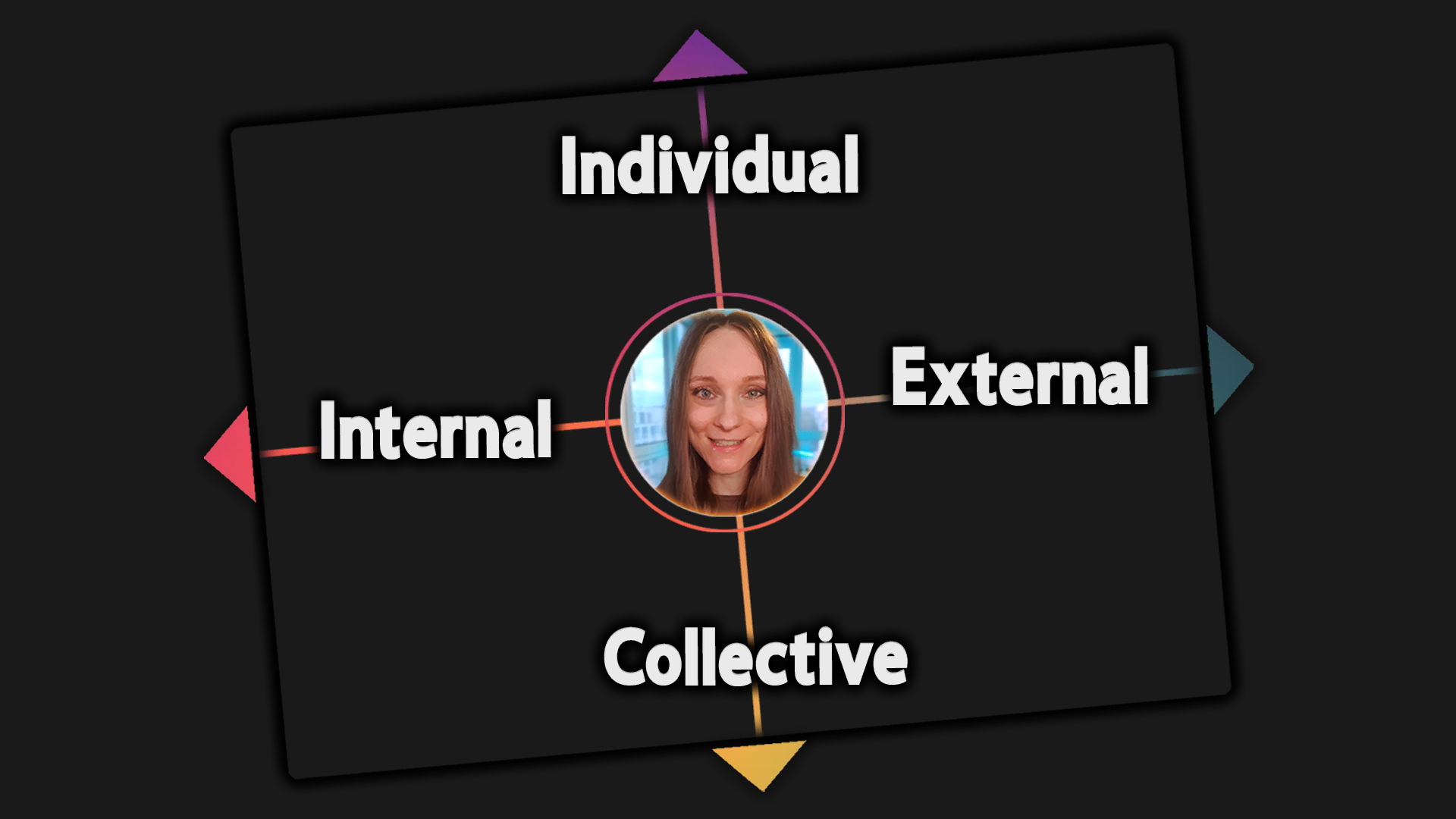
Imagine a line stretching from left to right.
On the left, we find the internal aspects of reality – our thoughts, feelings, beliefs, and inner attitudes. Everything that happens in our consciousness and remains invisible to others.
On the right, we find the external aspects – our behavior, actions, words, observable processes, and visible results.
Together, they form the internal-external axis. You could also think of it as inside vs. outside, or invisible vs. visible.
Now, imagine a line running from top to bottom, crossing the first one.
At the top, we find the individual aspects of reality – a person’s background, experiences, values, and actions. Everything that shapes the individual or arises from within them.
At the bottom, we find the collective aspects – what happens in interaction with others: shared values, group processes, and collective patterns of thought and action.
Together, they form the individual-collective axis. You could also call it I vs. we, or individual vs. community.
Together, these two axes form four quadrants.
The resulting Four-Quadrant Model was developed by Ken Wilber, an American philosopher and integrative theorist. He introduced it in the 1990s as part of his integral approach, showing that every human experience and development can be viewed through four fundamental perspectives.
Which brings us full circle: yes, inner work is necessary. But it's not the whole picture.
In coaching, I see these four perspectives as windows through which we can look at the different dimensions of the so-called holon – such as a person, a team, or an organization:
- Individual internal: feelings, beliefs, self-image,…
- Individual external: behavior, skills, actions,…
- Collective internal: shared values, relationship patterns, cultural norms,…
- Collective external: structures, processes, rules,…
Here’s the key:
Every change within a holon affects all quadrants!
Imagine changing your inner attitude. This will eventually show up in your behavior, influence the culture around you, and reshape your environment – and vice versa 🌱
My Integral Improvisational Coaching Approach consists of four different perspectives. Now you know why! Next up: What does it look like when all of this turns into a real coaching experience?
New to this series? Start here →

Christine Paulus
ENGLISH | DEUTSCH