
A brain has no CEO. A heart has no manager. Your body coordinates ~36 trillion cells without a boxy org chart. So why does your business need one?
We say “think outside the box” but no one does it. In fact, we love to think in boxes! Quite literally – just look at your current org chart.
We drew boxes and connected them with lines. Now we're surprised the boxes don't innovate and the lines slow things down.
You don’t hit your KPIs. Your team feels stuck and unmotivated. Your customers don't get what they want in the timeframe they want it. I see this in my coaching sessions: internal key players are overwhelmed, the few innovative people feel like nothing really moves. Younger generations apply at your competitor.
So what do you do?
You hire a new manager, merge two teams, let a person go. You put someone at the head of a process, push initiatives to improve value creation through new products and services.
But one thing never gets touched: the box.
Or should I say, the boxes.
Well – the boxes do get touched.
They get redesigned and it's called change.
Let's move these two boxes together. Let’s shift this one from left to right. Ah, here, let's write another name onto it. And that should get a new label. And if we now merge these two together, and move this whole set of boxes under this new box – perfect!
Well, is it?
You can look at all your boxes and say: yes, this structure is stable. Stable enough to operate as a well-oiled machine. But that's far from today's reality: global crises, tech breakthroughs, shifting expectations from team members and customers.
We need a structure stable enough to navigate this complexity and – at the same time – flexible enough to adapt when things shift.
We improved airplanes based on birds.
We improved bullet trains based on kingfisher beaks.
We improved wind turbines based on humpback whale fins.
Hm.
If only there was an example in nature that could inspire us on how to build an organization.
Oh, there is!
Let me introduce you to: the organism.
The boxy org chart is a 19th-century invention. The organism has been doing this thing called work for ~3.8 billion years. Maybe it's at least worth a look?
You know what I find exciting about a cell? It acts on its own, communicates with neighboring cells, and contributes its unique work to the larger structures of tissue, organ, and body.
And have you ever heard of one cell as the boss? Do you think they sit together in meetings, crafting slide decks and email responses, waiting for the boss cell to give the okay?
You don't.
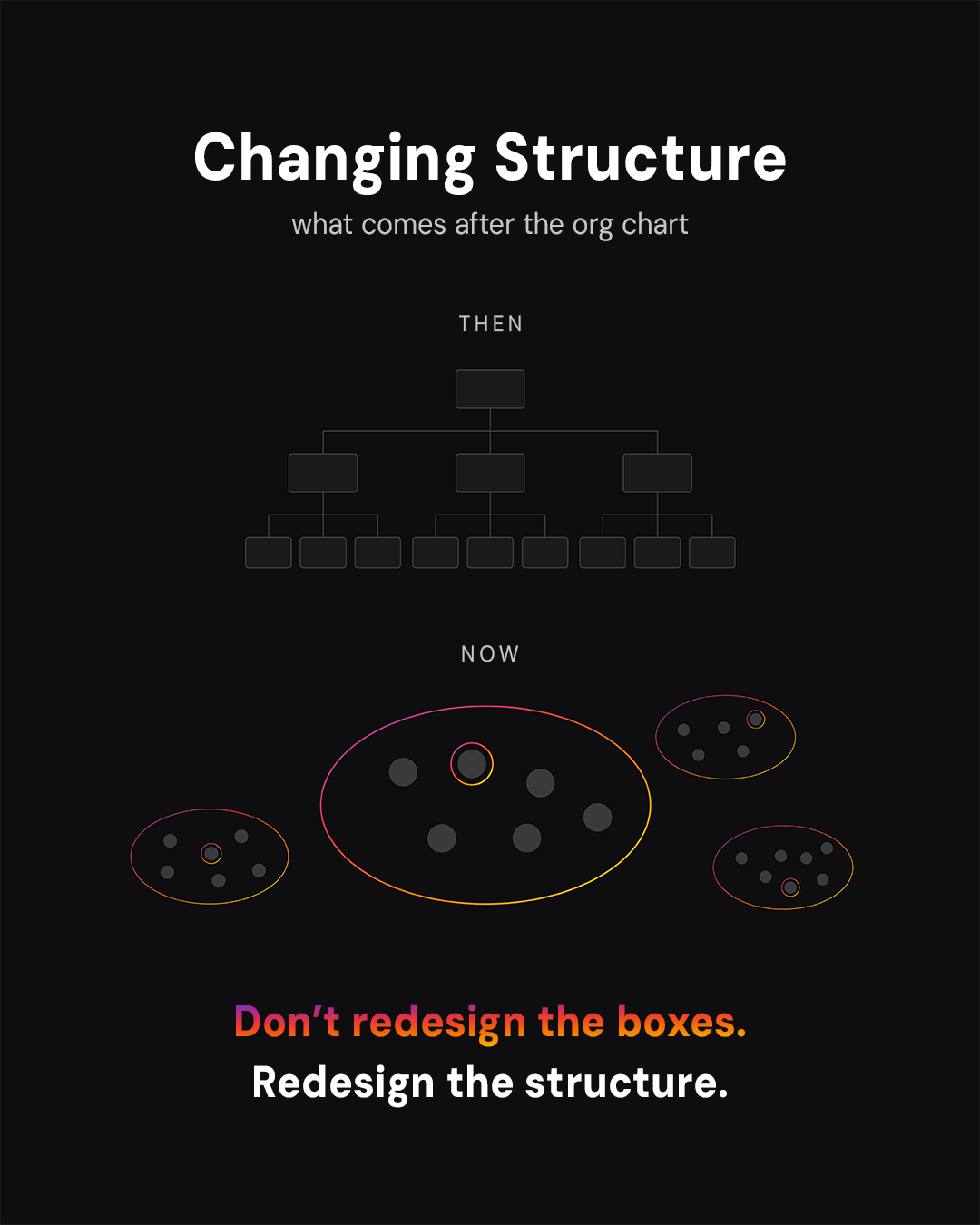
Even your brain is made of cells. And not one of them is in charge. Coordination happens through signals.
Besides “the mitochondrion is the powerhouse of the cell”, you might remember this from biology class: the membrane is selectively permeable. It's not a wall. But it's also not wide open. The cell decides what comes in, what goes out, what signals it responds to.
And it repairs – itself and its neighbors. No, they don’t file a ticket or wait for headquarters to decide.
Now imagine your business with decentralized leadership and dynamic roles.
Where cells – pardon: teams – collaborate, innovate, and contribute with real purpose, resilience, and collective intelligence.
Because if your current structure can't sense, signal, adapt, and self-repair, it's not built for what's coming. It's built for what already happened.
Forget the box. Think cell.

Christine Paulus
ENGLISH | DEUTSCH